Adventurers of Elandris Book 1: Venus Vanguard A Magical Empire Book 1 Part 2: Venus Vanguard by John Kim

Part Two
The Reckoning
✶ ✶ ✶
Chapter Five
The Waiting Night
✶ ✶ ✶
They were given chambers in the east wing of the palace, the rooms reserved for visiting dignitaries and the rare imperial agent who arrived with news the throne could not quite digest in a single sitting. Four rooms, four doors, one shared antechamber with a low fire and a long table and a bowl of moonflower-pears that someone had thoughtfully provided.
It was, by any measure, a generous arrangement.
None of the four of them used their separate rooms.
They sat instead around the antechamber table — Elyndra and Seraphina on one side, Aetherion Sol and Valerius Drakon on the other — with the fire low and the moonflower-pears uneaten and a single bottle of waystation wine, which Captain Holvar had pressed into Valerius’s saddlebag at the last moment, set in the middle of the table like an offering. None of them had touched it yet. None of them were entirely sure they wanted to.
The clock in the corridor outside rang the eleventh bell, then the twelfth. Then the first.
They did not sleep.
✶
It was Valerius who spoke first. He was the oldest of them, by some considerable margin, though he did not look it — battle-tempered humans of his line wore their years lightly until very near the end, and then all at once. He had been quiet since they entered the palace. He had been quiet, in fact, since the throne-room doors had closed behind them.
“Extinction event,” he said. He said it the way a man tests the weight of an unfamiliar weapon. “Two words. Easy to say. Difficult to fathom.”
“What does it mean to you?” Aetherion asked. Not challenging — asking. The mage and the warrior had clearly had this kind of conversation before.
“In the field, it would mean a campaign with no rear guard. No retreat option. No prepared fall-back position. And no reserve force. No rescue.” Valerius considered the wine bottle. “It would mean a commander who had decided to spend everything because there would be no second engagement. I served under Commander Venus once. Many years ago. The mission was a success. Commander Venus did not return.”
“And as a diplomatic term?” Elyndra asked.
“I am not a diplomat, my lady.”
“You’ve been in throne rooms. You’ve heard the language used.”
Valerius thought for a moment. “I have heard it used twice. Once by an ambassador from the deep north, regarding a plague among the snow elves that nearly emptied four valleys. Once by a dwarven envoy regarding a thing they had found in the deepest mines and collapsed all tunnels leading to the area and never spoke about again. In both cases the language was used precisely. In both cases what followed was bad enough that the people who survived stopped using the term entirely. Because it had proved, in their experience, insufficient.”
The fire shifted. A log settled.
Aetherion drew a long breath. “Then the Ambassador chose her words with care.”
“She chose her words with care,” Valerius agreed. “She also did not seem to be afraid. Which, in my experience, is a worse sign than the words themselves.”
✶
Seraphina, who had been very quiet since the throne room, set down the cup of water she had been holding and looked across the table at Aetherion.
“The seal,” she said. “The black-wax one. You told us in the courtyard that the Emperor and the Ambassador’s husband negotiated its terms four hundred years ago.”
“Yes.”
“That means the Emperor has known about her timeline for that long. He knew that there was an Ambassador. He knew someday, there would be a cause to invoke her.”
“Yes.”
“Then the Empress — our Empress — has also known.”
Aetherion shook his head slowly. “Not necessarily. The Emperor said something in the throne room that I think most of you did not hear. He said,” — and here Aetherion let the words come slowly, exactly — “‘I have honored your preference for four hundred years.’ He was speaking to the Empress.”
Elyndra had been listening with the still attention she gave to important things. Now she frowned.
“You’re saying the Empress did not know.”
“I am saying it is possible. Queen Ilaria — ours and the Federation’s both — appears to be mother to the Empress and to the Ambassador, in some larger sense, across the timelines. The Emperor said he had limited the interdimensional travels. Had kept the borders quiet. Done what the Empress asked, not what the Emperor wished. There is a distinction there, and I do not think it was accidental.”
Valerius made a small, dry sound that was not quite a laugh.
“You are telling us,” he said, “that the Empress has discovered today, in a throne room, in front of imperial agents and clerks with pens, that her husband has been holding a secret of cosmological scope from her for four hundred years, and that her own mother — or some larger mother — has been the one requiring the secret to be kept.”
“I am telling you that is one reading of what we witnessed, yes.”
“Then,” said Valerius, “the Empress’s composure tonight was the most impressive feat of self-discipline I have ever observed in any throne room. And I have stood guard in several.”
“She has had a lifetime of practice,” Elyndra said quietly. “The court has built itself around her composure for four hundred years. Tonight she had to choose, in the space of a single audience, whether to allow that composure to fail in front of every clerk present. She did not allow it. But Aetherion is right. Something failed in her face. I have been in the Empress’s audience seven times, and I have never seen what I saw tonight.” She looked at the fire.
“The scroll,” she said, after a moment.
Seraphina turned to her. “Indra.”
“The scroll she gave me. With the seal that Aetherion now tells us has been waiting four hundred years to be invoked.” Elyndra’s voice was steady, but the steadiness was the kind one chose carefully. “She gave it to me herself. With the Emperor present. With both of them sitting on the dais.”
“And?”
“And she said — when she spoke about Venus, about Aunt Venus, about the audience she had had with her — she said, ‘I did not change. But I never forgot.’” Elyndra paused. “Sera. She said it in the throne room, in front of clerks. She did not have to say it. She chose to.”
Seraphina was very still.
“You think she knew the scroll might be invoked. Even if she didn’t know about the Ambassador.”
“I think she knew something. I don’t know how much. I think she has been preparing for an hour she could not name, and that the preparation has cost her. And I think that when she gave me the Vanguard’s name — when she chose, in the throne room, to admit aloud that an old friend had told her she governed too cautiously — she was beginning to say something she has not been permitted to say for four centuries.” Elyndra looked across at Aetherion. “Does that match what you saw?”
Aetherion was quiet for a long time.
“It does,” he said at last. “It matches very precisely.”
✶
Valerius reached for the bottle. He did not open it yet. He set his hand on it, the way a man sets his hand on a weapon to know it is there.
“What does it change for us?” he asked. It was the kind of question only a Master-at-Arms asked, and only ever in the right moments. The question that cut through everything else.
Elyndra considered.
“It changes how I read the commission,” she said. “We were sent to find what is wrong in the Vale. We were told to add to our number from whatever willing hands we encountered. We were given a black-seal scroll that turns out to command authorities across timelines. We were called the Venus Vanguard, in a throne room, with the seal of the Sovereign upon us, by an Empress who had been waiting — perhaps without knowing exactly what she was waiting for — to call something by that name.” She looked at the three faces around the table.
“We are not investigators anymore. We have not been investigators since we crossed the threshold of the third waystation. We are something the empire has been holding in reserve for a long time. Possibly without entirely understanding what it held.”
“And the Ambassador?” Seraphina asked. “And whatever she is going to ask the Empress to do tomorrow morning in the moonflower garden?”
“The Ambassador is not the threat. The Ambassador is the warning. Whatever is in the Vale, whatever is approaching this world — she has come because her world has seen it before. Or seen something like it. And her side, whatever her side is, has decided we cannot face it alone.”
Valerius opened the bottle.
He poured four cups — short pours, the way one pours wine that is meant to mean something rather than to dull anything.
“To Captain Holvar,” he said, “who pressed this into my saddlebag and would not let me refuse.”
They drank.
“To Aunt Venus,” Seraphina said quietly.
They drank again.
Elyndra looked at her cup.
“To whatever the morning brings,” she said. “And to facing it with the people in this room.”
“Sword and shield,” Seraphina said.
“Sword and shield,” Elyndra replied.
Aetherion raised his cup. Valerius raised his.
“Mage and warrior,” said Aetherion.
“Mage and warrior,” Valerius agreed.
They drank.
✶
It was not yet dawn when Elyndra rose and went to the window of the antechamber. The moonflower terraces of the imperial city were folding themselves closed for the morning. The first thin grey light of pre-dawn was beginning to show over the eastern wall. In the courtyard below, a single light burned in the window of the Ambassador’s guest quarters. The Ambassador was awake. Of course she was. She had been awake, Elyndra suspected, for as long as the rest of them.
Seraphina came and stood beside her at the window.
“Indra. Whatever she tells the Empress in the garden this morning — whatever the Empress decides — we are going somewhere we cannot quite see yet.”
“I know.”
“Are you frightened?”
Elyndra thought about the question.
She thought about Aunt Venus, who had once told her, on a quiet evening in the Dawnshield gardens, that fear was a thing knights learned not to lie about — neither to themselves nor to the people they loved. That a knight who admitted she was afraid was, in nearly every case, also a knight who could keep moving.
“Yes,” Elyndra said. “I am frightened. Not as I have ever been frightened before. This is a different shape of fear. I do not know what it is yet.”
“Good,” Seraphina said. She slipped her gauntleted hand into Elyndra’s, the way she had been doing since they were both seven years old. “I am also frightened. We can be frightened together. We have done worse things together than be frightened.”
“Sera.”
“Yes?”
“Venus would have liked the wine.”
“Venus would have already finished the bottle.”
They stood there for a long moment, watching the sky begin to bloom from indigo into pale violet over the eastern wall, the way it always had over Elandris and the way it always would, for as long as Elandris stood.
Behind them, in the antechamber, Valerius and Aetherion had finally allowed themselves to fall asleep in their chairs, the warrior with his hand still on the hilt of his sword, the mage with his head tipped back and his breath even.
In the courtyard below, the Ambassador’s light went out.
She had risen, then. She had gone down to the moonflower garden.
The morning that would change everything had begun.
✶ ✶ ✶
End of Chapter Five
To be continued…
Chapter Six
The Mirror Empress
✶ ✶ ✶
The moonflower garden of the Palace of Elandris was kept by a single groundskeeper who had held the position for two hundred and sixty years and considered any conversation about his methods a personal affront. He did not like visitors before the tenth bell. He considered dew an argument in favor of solitude. He had, over two and a half centuries, trained the moonflowers to bloom slightly later near the palace gates, so that there was always a reason to discourage early arrivals.
He had never, in two hundred and sixty years, successfully discouraged the Empress. She was there before the ninth bell, as she was every morning she was in residence, sitting at the second bench from the east wall with her hands around a cup of tea gone slightly cold, watching the last of the night-blooming sections draw their petals closed against the approaching dawn.
✶
The Ambassador arrived as the ninth bell finished sounding.
She came through the green portal the way she always came — without announcement, without the shimmer that shadow portals gave off, without any of the atmospheric theatre that dimensional travel tended to produce. She wore her traveling clothes. The circlet of living vines in her hair was freshly woven, still wet with whatever dew existed in a timeline that was not quite this one.
She bowed. Lyriana bowed back.
“You have decided,” the Ambassador said. It was not a question.
“I decided last night. Somewhere between the second and third hour. I have spent the hours since reconsidering and arriving at the same conclusion each time, which I have taken as confirmation.”
She looked at the closing moonflowers.
“I will go,” she said. “Whatever is in the Vale — whatever approaches — I will not face it having refused the chance to understand what we are facing. That would be the kind of caution that is actually cowardice wearing sensible clothes.”
The faintest movement crossed the Ambassador’s face.
“Lady Venusia of Brightspire told you that once,” the Ambassador said. “In those words, or close to them.”
Lyriana was quiet for a moment. “She told me something like it, yes. Thirty years ago, in a private audience I have never repeated to anyone.”
“She told me something like it also. In my world. In a different form.” The Ambassador looked at the last moonflowers drawing closed. “She is the reason I chose the paths I chose. The ones that looked like they led away from the palace and turned out to lead further inside it than protocol allowed.”
Lyriana set down her cold tea. “Then we are both here because of her. In different ways.”
“Yes.”
“She would have found that amusing.” She stood. “When do we go?”
“Now, if you are willing. Empress Lyandra finds it easier to receive visitors before the nursery wakes.”
The ghost of an expression crossed Lyriana’s face. “She has children in the nursery.”
“Six.”
Lyriana straightened her circlet. It was already perfectly level. She straightened it anyway. “Then we should not keep her.”
✶
She told Amon at the gate.
He had been awake since before she was — she knew the look. The settled quality of a man who had sat with something difficult through the dark hours and arrived at dawn at peace with what he could not change, focused entirely on what he could. He looked at her for a long moment with his storm-cloud eyes. Then he said: “Come back having understood something I don’t.”
It was exactly what she had wanted him to say. After four hundred years he knew her the way deep water knows the shape of its bed — completely, without effort, without having to try.
“I will try,” she said.
He squeezed her hand. He let it go. She stepped through the green portal.
Part One: The Shadow World
The Shadow World was nothing like what the imperial library had prepared her for. She had read the seventeen volumes that existed on the subject — all produced at a comfortable scholarly distance by researchers who had studied through secondary sources and diplomatic dispatches rather than by stepping through a dimensional portal. They agreed on certain points: that the Shadow World was dark, cold, vast, ancient, and inadvisable to visit uninvited.
Not one of them had mentioned that it was beautiful.
Not the beauty of crystal towers and moonflower gardens — she knew that beauty and had lived inside it for four hundred years. This was different. The Shadow World had the quality of a sky between day and night, when the light has not entirely gone but the dark has already arrived. The silver trees held light without giving it back. The grass was a warm grey that carried more life in it than she had thought grey could contain.
Emperor Anon stood at the gate.
He was the same height as her Amon. The same broad shoulders. The same midnight-dark hair, the same mithril armor, the same four orbs turning their slow patient circles. She had prepared herself for this, the way one prepares for something that cannot fully be prepared for.
He bowed. “Empress Lyriana. Welcome to the Shadow World. I am glad you came.”
She met his eyes — storm-cloud grey, exactly as they were at home — and said, with the steadiness she had spent four centuries practicing, “Thank you, Emperor Anon. I am glad to be here.”
She was, to her considerable surprise, telling the truth.
✶
He walked her through it himself — not the formal parts, not the throne room or the war halls. He took her to the places that told the story beneath the story: the training courtyard where the worn stone remembered decades of practice. The silver library that existed partly outside any single dimension. The garden where moonflowers had been planted by someone who needed something to tend while she waited for her daughter to come home.
She had questions. He answered them.
“Your world,” she said, before a map drawn six centuries ago and still accurate. “It is larger than the reports suggested.”
“The reports your council receives were designed to provide enough information to prevent conflict and not enough to cause alarm. They have been very effective.”
“That was Amon’s decision.”
“And mine. We have made many of the same choices, your Amon and I. We have also made some very different ones.” He considered the map beside her. “In your timeline, the boundary between the Shadow World and the empire has been maintained by mutual preference. In ours, it held until your counterpart decided she wanted to know what was on the other side.”
He paused. “She was eight years old when she decided this. She hid behind a crystal pillar to eavesdrop on a state crisis and concluded she should cross the world to address it.”
Empress Lyriana was quiet for a very long moment.
“I remember that day,” she said.
“I thought you might.”
“I did not hide behind the pillar. There was a crystal pillar, and I was eight, and I considered it. I decided it was undignified.”
Something moved across his face that was very nearly a smile. “Yes. That is the difference.”
Part Two: The World That Asks
They moved on through the unified empire. Lady Mars received her briefly in the Light Empire’s administrative wing — amber-radiant and practical, a former senior advisor to Morningstar who now governed the rebuilt Light Empire from the same desk where, three years before, the previous regime had been signed out of existence. The conversation was brief and consequential. The Light and Shadow empires now traded freely, ran joint embassies, shared schools. Lady Mars had built much of it.
When Lyriana asked where she found the teachers for the new schools, Lady Mars answered without hesitation: We ask the Shadow Empire’s sisterhood. They have been building schools for forty years. I could spend thirty years reinventing their curriculum or six months asking what worked.
She paused, and added, “The reluctance to ask was pride. The dinner table was the cure.”
Then they went to the world itself — the main world, the world that in Lyriana’s timeline was called Elandris and in this one had taken a different shape under a different empress. And this was the realm that struck hardest. Not because it was so different from her own. Because it was so similar.
The same crystal towers. The same elven streets with their lanterns. The same human waystations on the long imperial roads, the same dwarven merchants in the market squares, the same orc warriors standing tall at garrison gates. If she closed her eyes and only listened, she could have been home.
But she kept her eyes open.
She saw an elven lord and an orc captain arguing about a trade route dispute — loudly, in the way of people who trust each other enough to be genuinely irritated rather than carefully diplomatic. She saw students in a courtyard: a high elf girl, an ice elf boy, a dark elf girl, a human boy, and a small dragon-child who kept accidentally breathing frost on everyone’s notes and being apologized to rather than scolded. She saw a dwarf master-smith leaning across a forge with an elven apprentice, showing her something that lived in hands rather than books.
She saw, in other words, a world that had learned to pool its talent.
And she understood, for the first time in a long and careful and well-administered reign, what her own world was missing.
It was not resources. Not peace. Not intelligence or will or governance or any of the things that could be measured in ledgers.
It was the practice of asking.
Part Three: Dinner with the Sisters
The weekly dinner happened that evening.
No announcement. No ceremony. Empress Lyandra had discovered, over years of welcoming people to this table who were initially afraid of what it meant to be there, that the quieter the welcome, the faster the fear faded.
So when Lyriana was brought in, it was simply: sit down, there is soup, Tiamat is unleashing her dragonian appetite. Umbra has strong opinions about whether bread comes before or after the soup, decide quickly which side you are on.
Lyriana sat down.
She looked at the faces around the table. Spring-green eyes that matched her own. Winter-blue eyes she had never seen on any living creature. Violet eyes from the dark elf queen who assessed her with the careful attention of someone who had spent a great deal of time in hostile courts and still catalogued exits by habit. The dragonoid beauty of Tiamat — Dragon Lord and mother to all dragons. The amber radiance of Lady Mars, three seats away, failing, quite subtly, not to stare.
And at the head of the table, Empress Lyandra of the unified Shadow Empire. Same silver curls, still wild, still refusing discipline. Same spring-green eyes. The warm smile Lyriana recognized because she had worn it herself for four hundred years and had stopped, somewhere along the way, without noticing she had stopped.
They looked at each other across the table.
“The soup is Rohka’s,” Lyandra said. “If you like spice, go gently. She has strong feelings about what constitutes a reasonable amount of pepper. It is a very good soup.”
Lyriana picked up her spoon. The soup was excellent.
✶
What happened over the following three hours was not easily summarized in diplomatic language, because it was not a diplomatic event. It was dinner. Seven women eating and talking and arguing and laughing and occasionally disagreeing and then, because there was a rule at this table that no argument went unresolved, finding their way back to each other.
Yisandra told a story about ice fishing that was simultaneously a treatise on cold-weather survival, a character study of an elderly ice elf with strong opinions about fishing lines, and funnier than it had any right to be. Umbra said four words — he deserved the dunking — and they were the funniest four words of the evening. Sonya argued with Umbra about governance with the specific ferocity of two people who fundamentally agreed on the destination and disagreed fiercely about the road. Tiamat’s projection arrived twenty minutes late and was entirely unapologetic. Lyriana watched all of it.
What she noticed was this: these women were not performing friendship. They covered each other’s weaknesses without being asked, because they knew each other’s weaknesses intimately. They disagreed without anyone losing standing, because no one’s standing rested on being always right. And underneath everything was a foundation she could not see directly but could feel. The way you feel deep roots in old earth.
She tried to imagine what would happen if one of these women were removed. Lost to illness, to war, to the ordinary catastrophes that unmake things.
She thought of what had happened to Queen Ilaria when King Aldric died. She thought of what had happened to the Ice Elves when King Icelar lost his Isolde. Then she looked at the table again and understood why neither of those things could happen here. Not because loss was impossible. Because each of these women was, for the others, a continuation and a reason. If Lyandra were somehow lost, the empire would not dissolve into grief — the network of care she had built would still exist, still know what it was for, still carry the project forward.
She thought of her own empire. Of Amon beside her on the throne. Of her council, excellent and reliable. Her generals, her diplomats, her administrators — all of them competent, all of them loyal.
She thought of what would happen if she were lost.
Her empire would continue. Correctly. By protocol. Amon would grieve. The council would manage. The machinery would grind on.
But there was no one at her table who would carry forward the spirit of what she had tried to build, because she had never built a table.
She had governed an empire.
It was not the same thing.
✶
Lyandra caught her eye across the breadbasket.
She said nothing. She simply met Lyriana’s gaze and held it, the way you hold someone’s gaze when you understand what they are thinking.
Lyriana, who had given nothing away in her face for four hundred years, gave something away.
Lyandra looked at it. Looked at it with the spring-green eyes that they both shared. She poured Lyriana more tea.
Part Four: The Offer
The formal meeting happened the following morning, in the private war room off the shadow library. Round table, six chairs, the shadow-map of all known dimensions breathing softly on one wall.
Anon and Lyandra on one side. Empress Lyriana across from them. The Ambassador at the end. Master Hanzo in the shadow beside the bookcase that was not technically an occupied space, and yet was.
✶
“You have seen three realms,” Anon said. “What did you understand?”
She gave the honest answer.
“That my empire has been governed by one person’s excellent judgment for four hundred years, and that this is a more fragile foundation than I believed. And that there are things approaching my world that one person’s excellent judgment is not sufficient to address. And that my world does not, currently, have anything more than that to offer.”
Anon nodded. “Tell me about the Vale.”
✶
She told it clearly. The silence around Wyrmwood Vale. The investigation parties that had stopped returning. Aetherion Sol, half-drained of life, carried out by a horse that had refused to abandon him. Valerius Drakon, found alive with the look of a man who had inspected death’s hinges from the inside.
And the presences. The thing that moved like wolves and looked like something older than wolves. That suppressed arcane magic from the moment you crossed its borders. When Lyriana finished, Lyandra looked at Anon.
“The dungeon signature,” she said quietly.
“Yes,” he said.
He turned to Lyriana. “We have encountered what is in your Vale. In our timeline, in the dwarven mountain territories. An ancient structure of the Light World — predating this age by a hundred thousand years at minimum. It generates entities from condensed life energy and feeds on the ambient magic of whatever lives near it.”
“What does it require to destroy?” Lyriana asked.
“Green Magic,” said the Ambassador.
The words fell with the clean weight of something that had been true before it was spoken.
✶
The Ambassador explained it plainly. Standard arcane magic operated on the precise frequency the dungeon entity could suppress and feed upon — that was why Aetherion Sol’s channels had been drained. Nature magic operated on a different frequency entirely. The entity could not metabolise it. Could not suppress it.
She said it without softening: “Your empire has not had a druid of standing in one hundred and twenty years.”
Lyriana said: “No. We have not.”
Then Amon spoke. He did not reach for softness. Four thousand years was long enough to understand that the kindest version of a difficult truth was the one that wasted the least of the other person’s time.
“Empress Lyriana. The Vale is a contained threat. If it were only the Vale we would help you address it and wish you well. But the Vale is the first thing that has arrived. What is behind it is larger. Your timeline has been fortunate. The tests are beginning. And your world faces them with a single point of failure where it should have a network.” He held her gaze.
“This is not a judgment of your reign. The failure is structural and older than you. An empire that concentrated everything in one excellent center and did not build the redundancy around it that would allow the center’s loss to be survived. I have watched this pattern end empires. I have watched the same pattern, differently managed, survive things that should not have been survivable.”
A pause. “Accept our help. Not because you cannot face this alone — you are not a woman who cannot face things alone. But because facing it alone, in this case, is a choice with a particular name.”
He left the name unspoken.
Empress Lyriana said it herself. “Extinction.”
“Yes. Your world has been narrowing. Ours has been expanding. Accept our help and learn to build that. Or face what comes with what you have.”
✶
Empress Lyriana was quiet for a long moment.
She was thinking about Commander Venus, who had told the Empress that she governed too cautiously, the way an old friend tells the truth. She was thinking about the dinner table, and the soup, and the way four words from Umbra had been funnier than anything she could recall from four hundred years of formal occasions. She was thinking about the night she was eight years old and considered hiding behind a crystal pillar and decided it was undignified.
“What would you send?” she asked.
Lyandra answered.
“Our Ambassador. She carries Green Magic — the deep-earth frequency the entity cannot suppress. She can walk into Wyrmwood Vale where your mages cannot. With her, two companions: a druid — half-elf, Lunar Circle — who can read the life energy of the land and find the dungeon’s roots. A ranger — Duskwalker — who can move through any environment the dungeon generates and find every living thing inside it. Both travel with their wolves. And from our Void Prison — a rogue of exceptional skill, whose time in the space between dimensions has given her a relationship with dimensional interior structures that most mortals cannot access. The dungeon’s interior is built on dimensional architecture. She moves through it as naturally as walking.”
She met Lyriana’s eyes. “Four people. The Vale does not need an army. It needs four specific things an army cannot provide.”
✶
Empress Lyriana looked at the shadow-map. At the point corresponding to Wyrmwood Vale — the pulse of it, patient and slow.
She looked at Empress Lyandra.
“I would like to come back,” Lyriana said. “After the Vale. To understand what it took to build what you have built. Not to replicate it exactly. But to understand the principle of it. To begin learning what I should have been learning for four hundred years.”
Lyandra’s face did something then that Lyriana recognized and had missed without knowing she had missed it.
It smiled. The real one — warm, unguarded, entirely genuine.
“You are always welcome here. That is the rule of this table. Come on a Thursday. Bring nothing. The soup is always slightly too spiced. We have all made our peace with it.”
She pushed the tea across.
“Everything begins somewhere. Ours began with a table and the habit of sitting at it. That is a beginning you can have.”
Part Five: The Dispatch
The green portal opened in the working courtyard at first light.
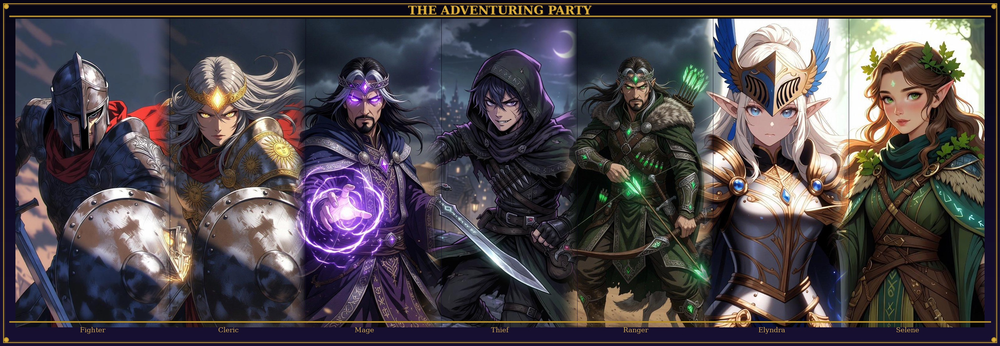
The Ambassador stood at the center in her traveling greens, the living vines fresh in her hair. Beside her, Selene Moonfang — half-elf druid, Lunar Circle — with Lunara the Lunar Dire Wolf at her left. At Selene’s right, Kaelen Ashthorn — ranger, Duskwalker — with Dusk at his heel. The fourth stood slightly apart: Nyx Vexley, with the Collar of Three Bindings at her throat in white, silver, and gold.
✶
Anon came forward.
“The Vale suppresses standard arcane magic from the moment you enter its boundary. Move in the channels it cannot recognise. The Ambassador will locate the dungeon’s roots. Selene will find the means to sever them. The lost investigation parties are alive — the entity feeds slowly. Find them. Retrieve them. Come back.”
He looked at the Ambassador last. “You know this world better than I do. Trust that.”
She bowed. “I will.”
✶
Lyandra stepped forward. Just one step.
“You know where to come when it is done.”
“Thursday,” the Ambassador said.
“Thursday. Bring everyone you find. Let them eat and ask questions. Let them decide what they think of us.”
The Ambassador smiled. “I think they will have a great many questions.”
“Good. This table has never run short of answers.”
✶
Selene Moonfang walked through the portal first. Lunara went beside her, and the grass leaned until she was through. Kaelen Ashthorn followed with Dusk. Nyx Vexley went next, fluid and unhurried, already — by no visible mechanism — somewhat less present than she had been a moment before.
The Ambassador paused at the threshold. She turned back. She looked at Empress Lyriana.
She held her gaze for a moment — spring-green eyes to spring-green eyes, the same eyes in two different faces.
“When you come back on Thursday, ask about the beginning. Not the sisterhood as it is now. The beginning. How the first table was set. How the first invitation was made.”
“What will she tell me?”
“That it was one dinner. And then the next Thursday, another. That is all it was. That is all it ever needs to be.”
She stepped through the portal.
The green light closed behind her — gently, the way a forest closes around a path when the last traveler has passed. Not gone. Waiting.
Empress Lyriana of the Empire of Elandris stood in a courtyard that was not her own and felt, for the first time in a very long and carefully administered reign, the particular sensation of a woman who has seen the road she did not take and is, against all expectation, grateful for the seeing.
It was not too late.
That was what the courtyard, and the table, and the spring-green eyes of the woman who might have been her had told her, across three realms and three days. It was not too late to set the table.
She looked at the closed portal for one more moment.
Then she turned and walked back inside — through a palace that was not quite her own, toward a world that needed her to go home and begin.
✶ ✶ ✶
End of Chapter Six
To be continued…